Beginners can build strength at home with a handful of simple movements: sit-to-stands, mini-squats, calf raises, wall press-ups and biceps curls with light weights. The NHS advises strengthening activity on at least two days a week, working the major muscle groups, and building up gradually.
What counts as strength exercise?
Strength exercise means making your muscles work against resistance, whether that is your own bodyweight, a resistance band or a weight. According to the NHS, the activity does not have to happen in a gym. Its list of examples includes push-ups, sit-ups and squats, resistance bands, lifting weights, yoga, tai chi, climbing stairs, dance, and heavy gardening such as digging and shovelling. Carrying heavy shopping and lifting or carrying children also count.
The NHS describes the right level of effort as working to the point where you need a short rest before repeating the activity. In other words, it should feel like work. A movement that feels effortless is not doing much for your muscles, while one that feels demanding but controlled usually is.
How often and how much should a beginner do?
The NHS guidance for adults aged 19 to 64 is to do strengthening activities on at least two days a week, covering all the major muscle groups: legs, hips, back, abdomen, chest, shoulders and arms. This is separate from the aerobic target of at least 150 minutes of moderate activity or 75 minutes of vigorous activity a week. If you want to see where strength fits in the bigger picture, our guide to how much exercise you actually need sets it out.
For repetitions, the NHS suggests aiming for 8 to 12 repetitions of each activity, which counts as one set. It advises at least two sets, and three for more benefit. The NHS also says to start gradually and build up over a period of weeks.
Its home routine for people who have not been active for a while is gentler. It asks for about five repetitions of most movements, and says to increase the repetitions slowly over time. Treat the 8 to 12 figure as a destination, not a day-one demand.
| Stage | What to aim for |
|---|---|
| Starting out | About 5 slow repetitions of each movement, as in the NHS home routine |
| Building up | Gradually add repetitions over weeks |
| Established | 8 to 12 repetitions per set, at least 2 sets, 3 for extra benefit |
Which exercises should you start with?
The NHS home routine uses seven movements. A solid, stable chair without wheels (and ideally without arms) is the main equipment, and filled water bottles can stand in for light weights.
- Sit-to-stand: about 5 repetitions. Go slowly, use your legs rather than pushing with your arms, and keep your eyes forward.
- Mini-squats: about 5 repetitions. Keep your back straight and your knees over your big toes, and squeeze your buttocks as you stand.
- Calf raises: about 5 repetitions. Lift your heels slowly while holding a chair for support. Letting go makes it harder.
- Sideways leg lift: about 5 repetitions per leg, keeping your hips and back straight rather than tilting.
- Leg extension: about 5 repetitions per leg, holding each lift for up to 5 seconds and avoiding arching your back.
- Wall press-up: 3 sets of 5 to 10 repetitions, with your back straight and your elbows close to your sides.
- Biceps curls: 3 sets of 5 per arm with light weights. These can be done seated.
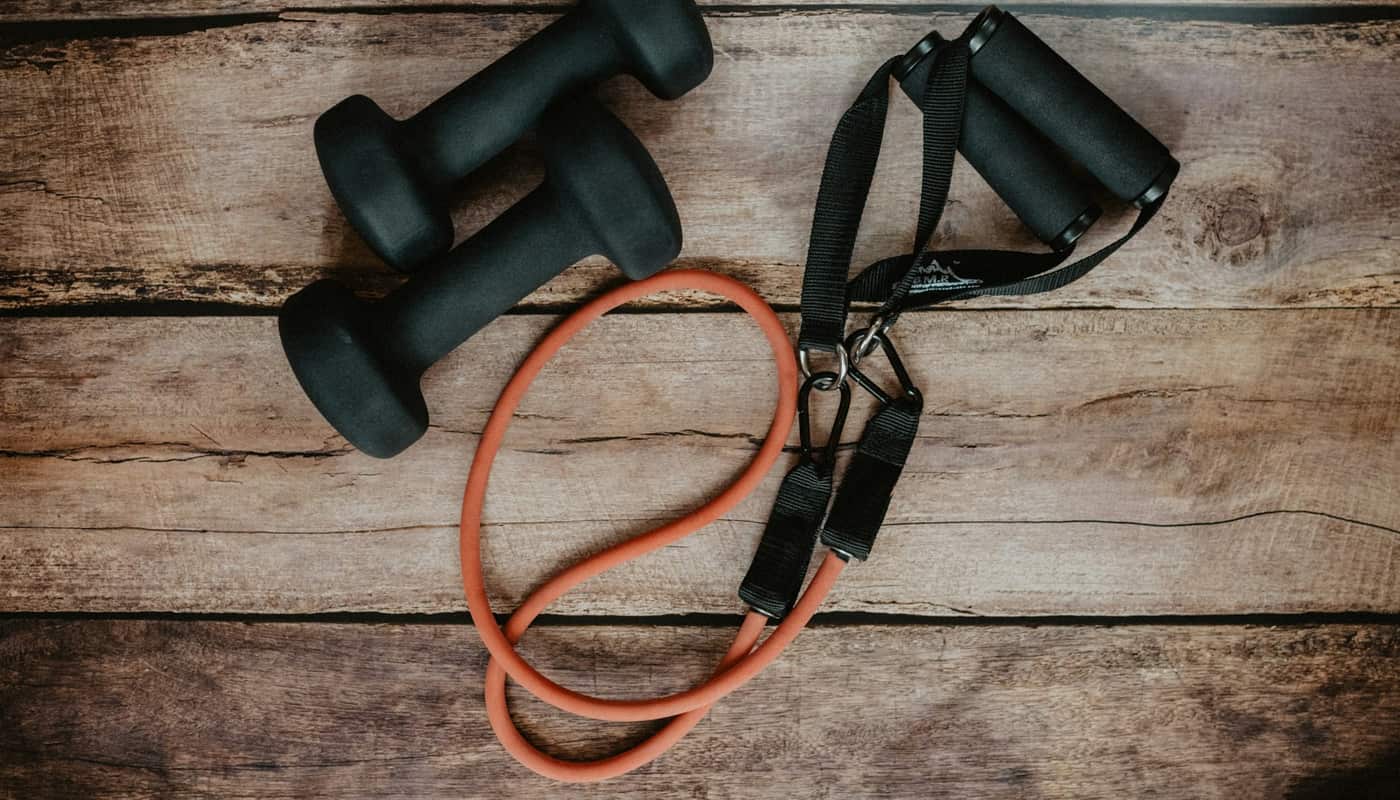
Together these cover legs, hips, chest, shoulders and arms. The NHS list does not include a dedicated movement for the back or abdomen, so once these feel manageable you could add something such as a resistance band row. The NHS names resistance bands as an option, though its home routine does not include band exercises.
What does a first week at home look like?
This is an illustrative plan built from the NHS movements, not an NHS programme. Two sessions a week meets the minimum guidance.
- Day one: two rounds of sit-to-stand, mini-squats, calf raises and wall press-ups, about 5 repetitions each, resting as needed.
- Day four or five: repeat, then add the sideways leg lift and biceps curls.
- Following weeks: add a repetition or two per exercise when the current number feels comfortable.
Worked example of progression: if you start with 5 repetitions of sit-to-stand and add one repetition each week, you would reach 8 repetitions in week four and 10 in week six. In practice, progress will not be so tidy. Some weeks you will hold steady, and that is fine. Warming up first helps, and our piece on warming up and cooling down covers what the NHS advises.
Is it safe to start strength exercise if you are out of practice?
For most people, gentle movements like these are a reasonable place to begin, and the NHS describes its home routine as suitable for people who have not been active for a while. Safety mostly comes down to a few habits that the NHS routine builds in:
- Move slowly and in control rather than rushing.
- Hold a chair or wall for support where the exercise calls for it.
- Keep your back straight in squats and avoid arching it in leg extensions.
- Use a stable chair that will not slip.
- Wear loose clothing and keep water nearby.
Mild muscle tiredness is normal. If soreness lingers, our guide to rest days and recovery explains what helps and what does not.
Common mistakes and misconceptions
Doing too much too soon. Eagerness is the usual enemy of consistency. The NHS advice to build up over weeks is there for a reason.
Believing you need equipment. Bodyweight, a chair, a wall and two water bottles are enough to start with. Dumbbells or bands can come later if you want them.
Rushing the repetitions. The NHS repeatedly says to go slowly. Speed makes an exercise easier to complete but gives your muscles less to do.
Ignoring the harder end of effort. The NHS says the aim is to reach a point where another repetition would be difficult to do without help. If you finish a set feeling you could do twenty more, the exercise is probably too easy and it is time to progress.
Thinking strength work replaces everything else. Strength activity sits alongside aerobic activity rather than instead of it, and the NHS also recommends balance work for some groups.
What varies from person to person?
How quickly you move from 5 repetitions to 8 to 12 depends on your starting point, your health, your sleep, your joints and how regular you are. The NHS routine is described as gentle, but gentle is relative. What is easy for one person may be demanding for another, which is exactly why effort, not a fixed number, is the guide.
Age, health conditions and injuries also matter. If you are older, our article on balance exercises and falls is a useful companion, because balance and strength support each other in everyday life.
When to speak to a GP or NHS 111
The NHS strength pages do not give detailed medical advice on this, so the following is general good sense rather than a quotation. Speak to your GP before starting if you have a heart condition, uncontrolled high blood pressure, significant joint problems, are pregnant, or are recovering from surgery or injury. Stop and seek advice if an exercise brings on chest pain, severe breathlessness, dizziness or faintness, or sharp joint pain. For urgent concerns, call NHS 111, and in an emergency call 999.
Starting small and staying consistent
A chair, a wall and a few water bottles are enough to meet the basic strength guidance. Start with about five slow repetitions, do them on two days a week, and add repetitions over weeks until 8 to 12 per set feels like real work. Regularity matters more than any single session.
This article is general information, not a substitute for advice from a doctor or other qualified health professional. If you are unsure whether exercise is right for you, speak to your GP or call NHS 111.
Sources: NHS